Cell design and simulation
Layout, reach and cycle-time studies to confirm the cell can meet your target before hardware is ordered.
Services Robotics integration
Robotics integration
A robot is only as good as the cell around it. We integrate robots with your parts, fixtures, conveyors, vision and machine controls, so the cell runs shift after shift, not just in the demonstration.
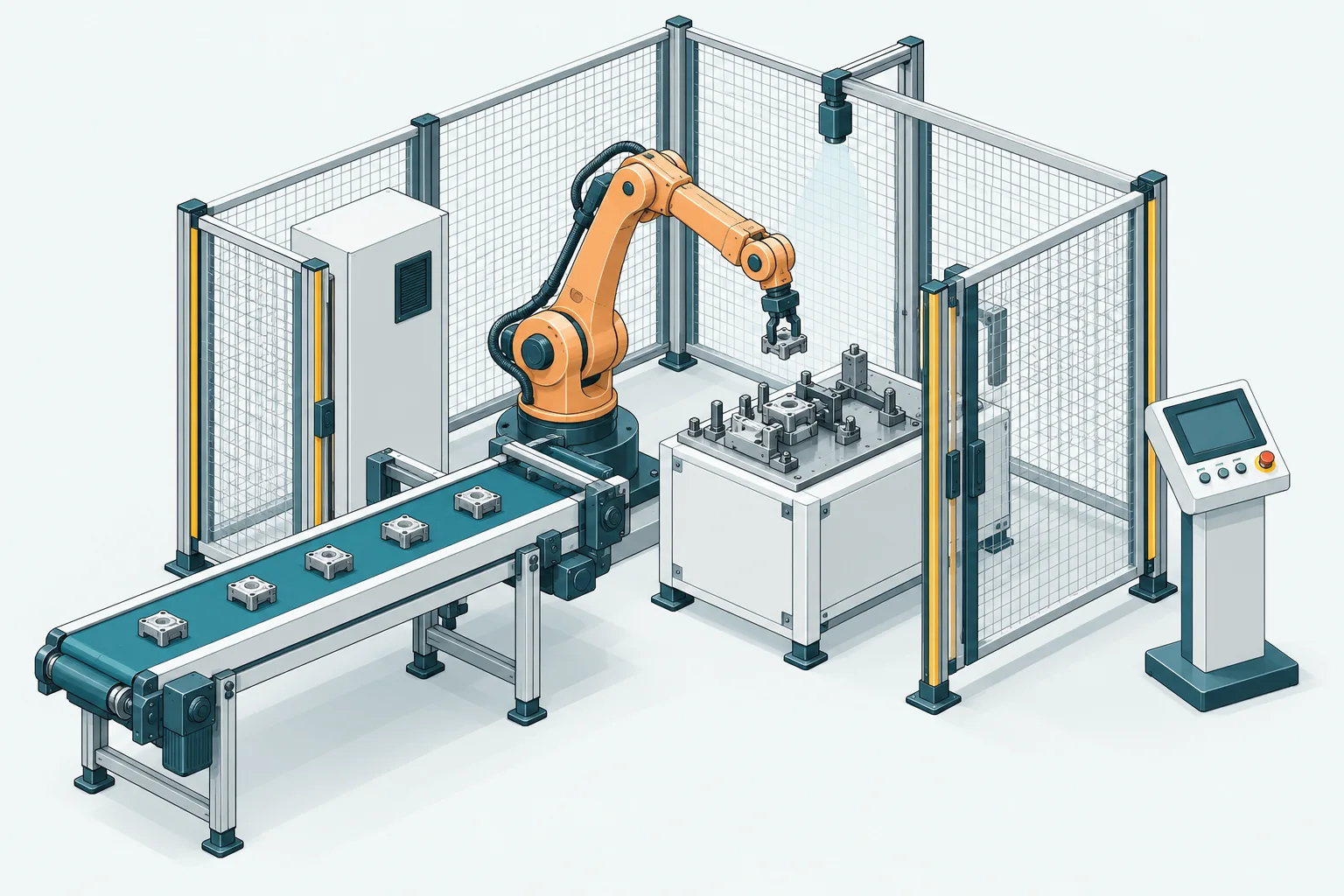
Robots earn their keep on tasks that are repetitive, heavy, hazardous or need the same precision every time.
The robot, and everything that makes it productive: tooling, part presentation, vision, controls and safety.
Layout, reach and cycle-time studies to confirm the cell can meet your target before hardware is ordered.
End-of-arm tooling and fixtures designed for your parts, including changeover for part families.
Cameras to locate parts, check orientation and inspect features, so the robot can handle variation.
Handshakes with CNCs, presses, moulding machines and conveyors through the PLC, so the cell works as one system.
Fencing, interlocked doors, light curtains and safe zones designed into the cell from the start.
Cycle proving on your floor, operator and maintenance training, and documented recovery procedures.
We test whether the task suits a robot before you commit to one.
Request a feasibility checkReview the part, task, cycle time and variation, and say plainly whether a robot is the right answer.
Cell layout, tooling, vision and safety concept, with a simulated cycle time for your sign-off.
Assemble the cell and run trials with your actual parts before installation.
Commission on your floor, train your team and support the cell through its ramp-up.
Start with one cell on one well-understood task, and scale once it proves out.
It depends on the task, cycle time and number of shifts more than the total volume. The feasibility review gives you an honest answer before you spend on hardware.
Often, yes. Quick-change tooling, vision and stored programs let a cell switch between part families. We design for the variation you actually have.
Every cell is designed with guarding, interlocked access and safety devices appropriate to the task, and reviewed with your team before commissioning.
We do. We train your maintenance team for day-to-day recovery and stay available for programming changes and troubleshooting.
We select the robot that suits the payload, reach and environment of your application, and integrate it with everything around it.
One team for the shopfloor: each service connects to the others when your project needs it.
Let’s look at the task
Send a video of the task, the part weight and size, and your target cycle time. We’ll tell you whether a robot is the right answer, and what the cell would involve.
The demo is free, at no cost and with no commitment.