PLC programming
Structured, documented logic for machine sequences, interlocks and fault handling, on the PLC platform your plant standardises on.
Services Process & machine automation
Process & machine automation
We design and build the controls that make a machine or process repeatable: sensors that know where the part is, PLC logic that runs every step the same way, and panels built to last on an Indian shopfloor.
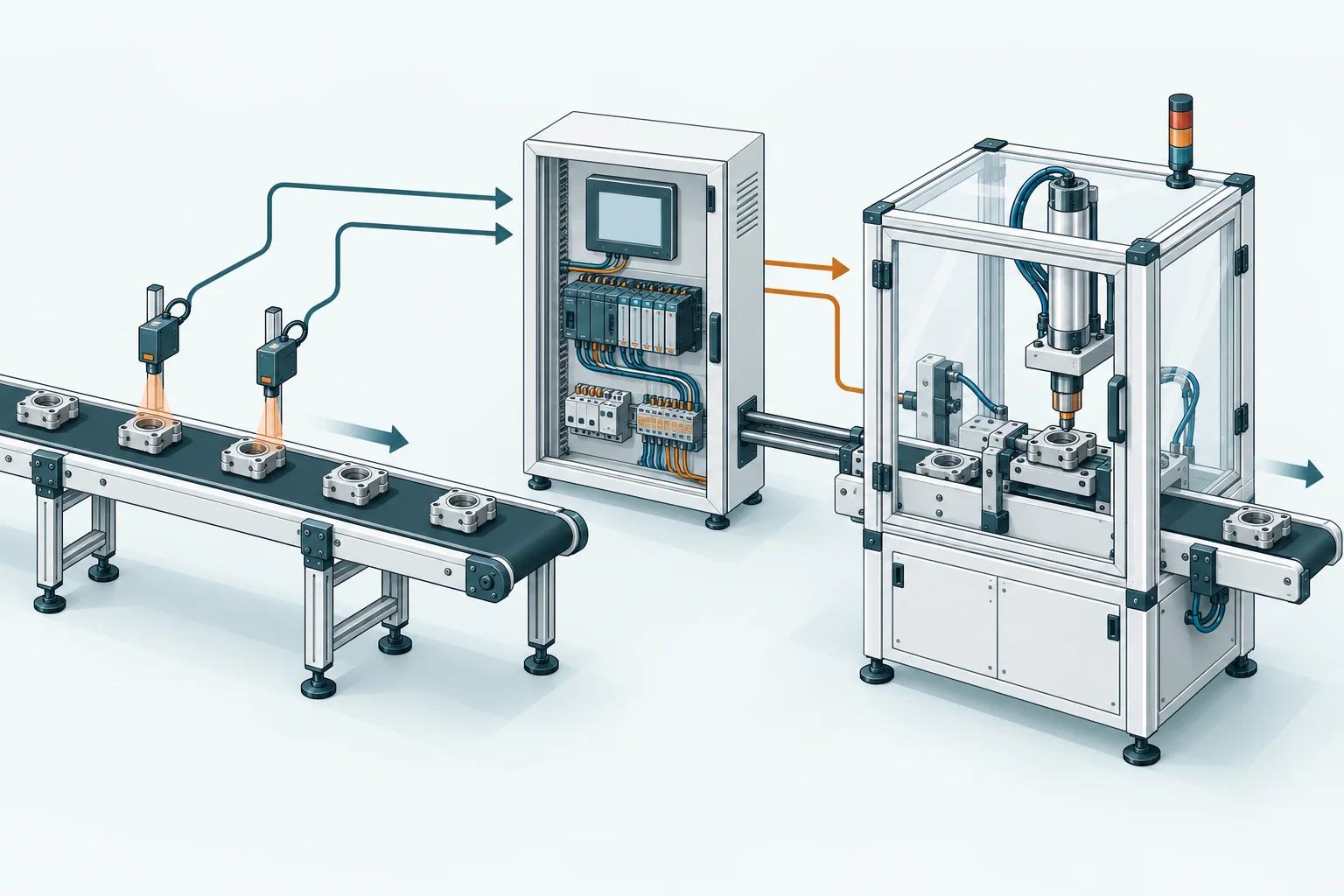
Automation pays when a task is repetitive, quality-sensitive or limited by how fast and consistently people can do it.
From a single sensor and interlock to a complete special-purpose machine, engineered, built and commissioned by one team.
Structured, documented logic for machine sequences, interlocks and fault handling, on the PLC platform your plant standardises on.
Selection and installation of proximity, photo, pressure and position sensors, along with pneumatic and motor-driven actuation.
Panel design, wiring and testing for control, MCC and machine panels, with clear labelling and drawings for your maintenance team.
Simple operator screens for recipes, counts, faults and manual modes, laid out the way your operators work.
SPMs for drilling, pressing, assembly, testing and marking, designed around your part and target cycle time.
Replace relay logic and obsolete controllers on machines that are mechanically sound, with drawings updated to match.
Every project is engineered on paper and proven at our end before it touches your production.
Share your processStudy the part, the current method, target cycle time and quality requirements on your shopfloor.
Concept, sequence, electrical design and bill of materials, reviewed and approved with you.
Panel build, programming and trials, simulated or run with sample parts before dispatch.
Install, prove the cycle on your floor, train operators and maintenance, and hand over drawings and programs.
Small, focused automation often pays back faster than a full line, so we take on both.
We work with the major industrial PLC platforms used in Indian plants, and we prefer the one your maintenance team already supports so spares and skills stay in-house.
Yes. A single sensor, fixture interlock or semi-automatic station often removes the biggest source of errors at a fraction of the cost of full automation.
Yes. Electrical drawings, the PLC program and the operating notes are handed over at commissioning so your team can maintain the machine.
We plan installation around your schedule. Most of the work is built and tested off-line, and changeover is kept to a planned window.
Safety is part of every design: guarding, interlocks and emergency stops are agreed with your team and reviewed against your plant’s safety requirements.
One team for the shopfloor: each service connects to the others when your project needs it.
Let’s look at your process
Share a short video or photos of the process, the part and your target cycle time. We’ll come back with an approach and the questions that matter.
The demo is free, at no cost and with no commitment.